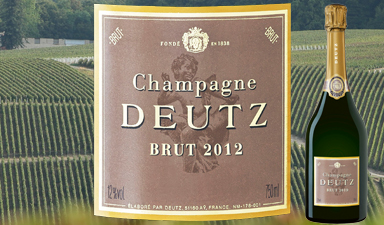
Deutz Cuvée Amour de Deutz Blanc de Blancs 2008 is crafted entirely from Chardonnay, sourced from Grand Cru vineyards in the Côte des Blancs, with a blend of 57% Avize, 38% Le Mesnil-sur-Oger, & 5% Villers-Marmery. Disgorged in December 2024, it underwent 15 years of lees ageing, resulting in a balanced profile with citrus and subtle patisserie notes. This champagne is suitable for drinking now through to 2040+. Champagne Deutz, located in Ay, one of Champagne’s most historic and renowned terroirs for Pinot Noir, on predominantly south-facing hillsides. The house was founded in 1838 by William Deutz and Pierre-Hubert Geldermann, two wine merchants from Aix-La-Chapelle. In 1993, Louis Roederer acquired Champagne Deutz and appointed Fabrice Rosset as CEO.
From the late 1990s, Rosset revitalized the brand, generating substantial income and reinvesting approximately €30 million into the cellars, winery, and infrastructure. Under the leadership of Chef de Cave Michel Davesne, who joined in 2003 and retired in 2023, the quality of Deutz’s wines significantly improved. Production, which was 600,000 bottles in 1996, has grown to 2.5 million bottles and continues to expand.
In 2022, Marc Hoellinger became CEO, ushering Deutz into a new era defined by a commitment to sustainable viticulture. The Maison owns 42 hectares of vineyards and sources additional grapes from growers across 300 hectares, all located within a 30-minute drive of the winery. Uniquely, Deutz produces three prestige cuvées: William Deutz, Amour de Deutz Blanc de Blancs, and Amour de Deutz Rosé. The Blanc de Blancs cuvées are among Champagne’s most refined, renowned for their precision, delicacy, and exceptional finesse. By 2023, the estate had transitioned to 100% organic farming, with certification targeted for 2026.
Weather: 2008 was dominated by grey, overcast skies – an exception in a decade characterized by bold, generous sunshine. Spring and summer rought the same lack of sunlight and absence of high temperatures. It was September that saved the vintage, belatedly and miraculously. Just when the harvest was getting underway (on September 15), the weather conditions were finally perfect: blue skies and prolonged north-northeasterly winds. Picking was spread out over a long period in order to benefit from this positive turn of events. The grapes were riper than anyone dared hope, and had truly outstanding balance. The vines were in perfect health.
Technical Information:
Vineyards: Grand Cru from the Côte des Blancs; 57% Avize | 38% le Mesnil-sur-Oger & Premier Cru from the Montagne de Reims; 5% Villers-Marmery
Grape Varieties: 100% Chardonnay
Disgorged: May 2019
Dosage: 8 g/l
Lees Ageing: 10 years
Drink: Now to 2040
Released: 2026
Champagne in clear bottles must be stored in complete darkness, it spoils quickly if exposed to any light source.
Read More
Tasting Note: The aromatics launch you into that world of gently smoky gunflint, the citrus spectrum of lemon and grapefruit is going into its dried fruit phase, with hints of patisserie coming forward. At this age, the champagne is slightly more gently spritz, which creates this super velvety texture with the interplay of freshness from the acidity. The fruits are showing complexity, with hints of bitter orange adding to the yellow citrus. A luxurious drinking phase has emerged. - Tasted by Nick Baker TFB Founder
Champagne Deutz, based in Ay, one of Champagne's historic and most renowned terriors. Founded in 1838 through the association of William Deutz with Pierre-Hubert Geldermann, both wine merchants from Aix-La-Chapelle. Their idea was that to make a great wine, first a great vineyard was needed, so they set off in the search for top local vineyards. Deutz soon became an international brand with Deutz and Geldermann using their knowledge and expertise of markets in their favour. Successors followed suit and tradition and through the 20th Century continued to purchase excellent vineyards in some of Champagnes best villages.
In 1993, Louis Roederer partnered with Deutz to save it from going into financial trouble, with Champagne Louis Roederer's help Deutz has increased production threefold and vastly improved methods and modernising cellars. Fabrice Rosset led Champagne Deutz from 1993 until his retirement in 2022, when Marc Hoellinger succeeded him as CEO. Deutz still strives for excellence, terrior and sustainable viticulture.
Location:
Ay
Chef de Cave History at Champagne Deutz:
Caroline Latrive 2022 to present: she was formerly the cellar master at Champagne Ayala, which is just up the road from Champagne Deutz.
Michel Davesne 2003 to 2023 is now retired. He played a pivotal role in guiding Champagne Deutz through a period of rapid expansion. When he joined in 2003, the company was producing 600,000 bottles annually, and by the time of his retirement, production had grown to 2.5 million bottles. Working alongside the now-retired CEO Fabrice Rosset, Deutz invested approximately €30 million in expanding the cellars.
In 2004, the company modernized and expanded its production facilities. A new disgorging line was introduced, boosting capacity to 3,000 bottles per hour, while the incorporation of jetting technology improved both the quality and consistency of the wines. The construction of a new fermentation hall allowed for the addition of new tanks (100-125 hl), enabling the winery to produce wines by village and even parcel, drawing on the estate's diverse vineyard holdings.
By 2011, growing sales prompted further investment. Fermentation capacity was increased from 17,000 hl to 30,000 hl, and additional stainless steel vessels were introduced, ranging from 25 hl to 300 hl, further enhancing the winery’s flexibility and production capabilities.
Annual production: 2,500,000 bottles