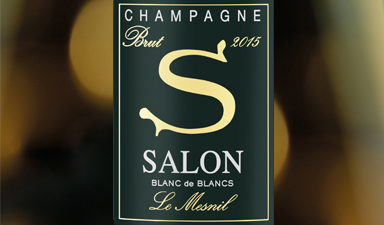
The fruit of the single-hectare vineyard of Jardin de Salon is currently declassified to Delamotte, as the vines are just 14 years old, and will not be included in Salon for at least another three years. This Champagne is therefore produced from 19 longstanding growers in Mesnil-sur-Oger, who sell their fruit only to Salon. There is no non-vintage, so production is limited to only the finest years, of which this release, 1999, is just the 36th since 1905. The wines are cellared in the bottle for an average of 10 years, gaining in complexity and finesse. With only 10 employees (six in the cellar and four in the office), riddling performed by hand and typically only 50,000 bottles produced; attention to detail is the key to Salon's prowess.
This 1996 Blanc de Blancs is Salon's 35th vintage from 100% Chardonnay; Salon describes it as “sensuality of silk.” This was a summer marked by hot and dry conditions, making for excellent ripening. The harvest commenced on September 22nd; during picking the weather was summery but with cold evening temperatures, which encouraged good acidity.
Salon is typically released at 10-12 years following the harvest. On release Salon is “fruit forward” and expressive, often “closing down” for anything from 3 to 10 years. It is after this time Salon really shines, the racy mineral freshness seem lessened and the fruit develops more than primary fruit character into an exquisite champagne with freshness, complexity & an abundance of dried fruits, especially orange, lemon and dried grass. There is no established “late disgorgement” program at Salon, a small numbers of bottles are often released at later dates like this parcel disgorged in the autumn of 2021. Confusingly the “late disgorged” bottles are labelled as normal so you would need to use our invoice and rotation codes in your bond to keep track of these. With longer lees ageing the late release Salon’s have a more “fresh profile” than the original release and will be more textural on the palate.
Vineyards: 100% Grand Cru | Le Mesnil-sur-Oger
Grape Varieties: 100% Chardonnay
Lees Ageing: 24 years
Disgorgement: Autumn 2021
Dosage: 7 g/l
Drink: Now to 2040+
Tasting Note: Stunningly complex bouquet of citrus oil, confit lemon, dried white flowers and oyster shell, with hints of praline and pastry cream becoming more pronounced as the wine opens up in the glass. On the palate, it's medium to full-bodied, deep and multidimensional, defined by the incisive spine so typical of the vintage that, here, is cloaked in layers of crisp fleshy and chalky extract. The finish is long, penetrating and saline. - Tasting by William Kelley
Champagne Salon Brand Overview & Buy Champagnes Same Day Delivery
Salon is one of the most intriguing and mysterious names in Champagne. It is also a most unusual wine: there is only one cuvée, it is produced only in exceptional years (there were only 37 releases in the entirety of the 20th century), it is made only from Chardonnay and it is sourced only from vineyards of the famous Grand Cru, Le Mesnil-sur-Oger. It is a rare and luxurious champagne, and new releases are always keenly anticipated with an average of only 60,000 bottles produced each vintage.
Early in the 20th century, Eugène-Aimé Salon, a wealthy businessman working in the fur trade in Paris, returned to his family’s roots in Champagne. His vision was to make a champagne like no other and purely from Chardonnay grapes grown in Le Mesnil. Arguably, this was the first ever ‘Blanc de Blancs’ champagne. Imagining a wine purely for his own pleasure, it began life as a hobby and he only made tiny quantities to consume with friends and family. After testing the waters with the 1905 vintage, Salon went full steam ahead in 1911, when Eugène bought a one-hectare vineyard in Le Mesnil-sur-Oger and officially created the Champagne house. He built a large mansion to throw lavish parties, but in fact the house was barely used, as Eugène’s focus remained firmly on his profitable fur business and his political career in Paris.
For his ‘hobby’ Eugène had been advised by his brother-in-law, a local winemaker, that the grapes from Le Mesnil were very high in acidity which resulted in powerful, very linear wines with great ageability. The grapes in Le Mesnil were Chardonnay, which at the time were considered less important than Pinot Noir in the production of Champagne. The common belief was that Chardonnay alone did not have enough body and structure to make well-balanced and high-quality champagnes. But, believing the wines could open up and impress if given enough time to develop, Eugène decided to let them age for a minimum of 10 years. His 1911 ‘Grand Vin Nature du Mesnil’ thus became the very first Blanc de Blancs champagne.
The house was headed by Eugène Aimé Salon until his death in 1943, when it passed to his sister Annie and nephew Marcel-Guillaume, who cared little for the wine business. They struggled along for the next 20 years and left the Chef de Cave to do his own thing. In 1963, the family sold the company to Dubonet-Cinzano, who showed little interest in developing the Champagne brand.
Things changed for the better in 1988, when Laurent-Perrier purchased Salon. Today, Salon exports 95% of its production. It was not imported into the United States until 1983. Remarking on the high price tag, the New York Times wrote: “Salon is likely to remain mostly invisible to the public; its appeal would seem to lie with those who fancy stratosphere-level wines.”
Didier Depond was appointed President of Salon in 1997 and remains director today.
Chef de Cave History at Champagne Salon:
Didier Depond: Champagne Salon Cellar Master 1997 to current
Didier Depond has served as the President of Champagne Salon and sister house Delamotte since 1997, overseeing the production of one of the world’s rarest Blanc de Blancs. Under his leadership, Salon maintains its commitment to producing a single cuvée from 100% Chardonnay in Le Mesnil-sur-Oger only in exceptional years, with long aging (10+ years).